
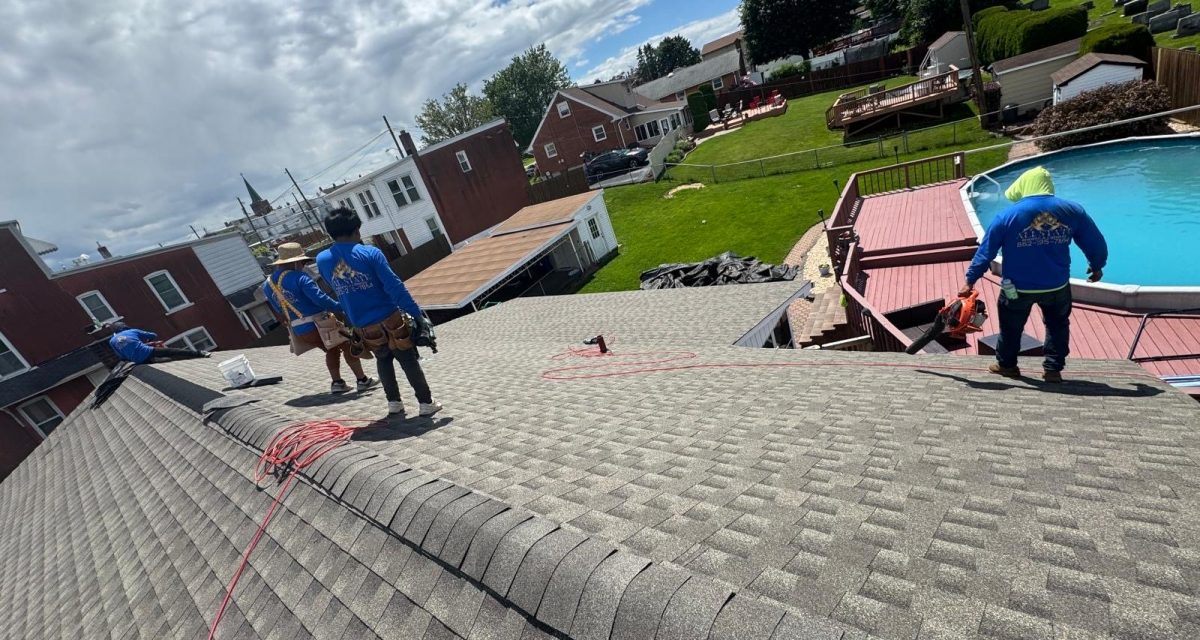
A professional roof is more than a clean pattern of shingles. The finished surface is only the visible part of a larger system that must work together to manage rainwater, resist weather exposure, protect the structure, and maintain the appearance of the property. The featured photograph provides a clear example of this relationship: a broad shingle roof is shown together with multiple masonry chimneys, roof edges, transitions, and upper roof surfaces.
This type of project demonstrates why professional roof and chimney services require careful attention to details that may not always be obvious from the ground. Shingles create the primary exterior covering, but the performance of the complete roof also depends on installation quality, flashing, transitions, penetrations, drainage, and the condition of areas around chimneys.
At All State Roofing and Chimney, the goal is to approach each project as a complete roofing and exterior protection system. Whether the property requires a new roof, targeted repairs, leak investigation, or chimney work, the condition of connected components should be considered before work begins.
1. What the Photograph Reveals About the Roofing System
The featured image shows a large shingle roof with a consistent pattern extending across the visible roof surface. Several masonry chimneys rise through or adjacent to the roofline, creating important areas where the roofing system must connect with vertical masonry surfaces.
From a visual perspective, the roof has long, continuous courses of shingles and clearly defined upper edges. The photograph also shows how much of a property’s exterior protection can be concentrated in one roof surface. Every shingle course, edge, transition, and penetration contributes to the overall roofing assembly.
A professional assessment should look beyond the appearance of the shingles. A roof can look relatively uniform from the ground while still having issues in concealed areas. That is why professional roof and chimney services often begin with inspection and evaluation rather than assumptions.
The U.S. Environmental Protection Agency’s moisture-control guidance identifies roof edges, roof intersections, skylights, roof hatches, chimneys, and other penetrations as locations that deserve careful attention when maintaining moisture protection. This reinforces an important principle: vulnerable connections need to be treated as part of the complete building envelope, not as isolated details.
2. Why Shingle Alignment and Installation Matter
The shingle pattern visible in the photograph illustrates how much surface area a roofing system can cover. Proper installation is important because shingles are arranged in overlapping courses designed to shed water toward the roof drainage path.
Alignment contributes to the finished appearance, but it is also part of organized installation. Consistent courses, correct placement, and appropriate fastening help create a professional roofing surface.
The exact installation method depends on the roofing product, manufacturer requirements, roof design, and applicable building practices. For that reason, a professional contractor should follow the specifications appropriate to the materials being installed instead of treating every roof as identical.
A homeowner may see only the finished rows of shingles. The contractor must also consider the layers beneath them, the roof edges, valleys, flashing, ventilation, and areas where the roofing meets other building components.
That broader perspective is one reason professional roof and chimney services can be valuable during a major roofing project.
3. The Importance of Roof Edges and Transitions
Roof edges may appear simple, but they are important parts of water management. The perimeter of the roof needs to direct water appropriately while protecting the underlying assembly from exposure.
Transitions are equally important. Whenever one roofing plane meets another surface, the installation needs to maintain continuity in the protective system.
The featured photograph shows multiple roof elevations and masonry elements. These changes create areas where workmanship matters. A professional crew must understand how water moves across each roof section and how the different components connect.
The goal is not simply to create a visually straight line. The goal is to maintain a functional roofing system from the upper roof areas down toward the drainage points.
Professional roof and chimney services should therefore include attention to edges, transitions, flashing, and other areas where materials meet.
The EPA also recommends paying attention to vulnerable areas such as roof edges, roof intersections, chimneys, valleys, skylights, and other penetrations because these locations are important to moisture control.
4. Chimneys and Roofing: A Critical Connection
The chimneys visible in the photograph are a major part of the roof’s overall construction. Masonry chimneys pass through or rise above the roof assembly, which means the surrounding roofing materials must connect properly with the chimney structure.
Chimney areas deserve special attention because they combine two different exterior materials and functions. The chimney needs to remain structurally sound and weather-resistant, while the roofing system must shed water around the chimney without creating pathways for moisture to enter.
This is where professional roof and chimney services can overlap. A roofing issue near a chimney is not always caused by the shingles themselves. The source can involve flashing, masonry deterioration, joints, caps, or other connected components.
A proper inspection should therefore consider both the roof and the chimney instead of automatically assigning the problem to one component.
For homeowners, this is especially important when a leak appears near a chimney. Water can travel along concealed paths before becoming visible inside the property, making the visible stain an unreliable indicator of the exact entry point.
5. Flashing Around Chimneys and Roof Penetrations
Flashing is one of the most important details in areas where roofing materials meet vertical surfaces. Around chimneys, properly installed flashing helps manage water at the intersection between masonry and the roof.
The EPA’s building moisture guidance specifically lists flashing at roof edges, valleys, chimneys, dormers, skylights, and other penetrations among areas that should be inspected and maintained. The agency also notes that roof and ceiling assemblies can deteriorate through weather exposure, building movement, improper design, construction, or maintenance.
This is why flashing should not be treated as a minor finishing detail.
During an inspection, a roofing professional may look for visible signs of deterioration, separation, damage, improper sealing, or other conditions that could affect water management. The appropriate repair depends on the actual condition of the assembly.
When chimney-related roofing work is required, the objective is to restore continuity around the intersection rather than simply covering the visible symptom.
Homeowners can also review professional information about chimney repair services when evaluating problems involving chimney components.
6. How Weather Exposure Affects Roofing Materials
A roof remains exposed to changing environmental conditions throughout its service life. Rain, wind, snow, ice, sunlight, temperature changes, and moisture can gradually affect exterior materials.
The impact is not necessarily uniform across the entire roof. Some areas may experience more exposure than others because of roof orientation, slope, nearby trees, drainage patterns, or architectural features.
Chimneys and roof transitions can also become important inspection points because they interrupt an otherwise continuous roofing surface.
Regular inspection can help identify visible problems such as damaged or missing shingles, deteriorated flashing, loose components, signs of moisture intrusion, or other changes in the roofing system.
The EPA recommends periodic inspection of roof and ceiling assemblies and additional inspections after heavy winds or rains or other events that could affect the roof.
Maintenance is particularly useful when a roof has several architectural features. Each additional intersection, penetration, or transition represents another area where the roofing system must maintain weather protection.
7. Roof Repair or Roof Replacement?
One of the most important decisions in a roofing project is determining whether a localized repair is appropriate or whether the entire roofing system has reached a point where replacement should be considered.
A repair may be suitable when the problem is limited to a specific area and the surrounding roofing system remains in serviceable condition. Examples can include isolated damage, localized flashing issues, or a limited leak source.
Replacement may become a consideration when a roof has widespread deterioration, repeated problems, extensive damage, or a condition that makes continued repairs impractical.
The correct choice cannot be determined from a photograph alone. A professional inspection is needed to evaluate the roof’s age, materials, visible condition, underlying components, and the scope of any damage.
All State Roofing and Chimney provides both roof repair and roof replacement services, allowing the project to be evaluated according to the actual condition of the property rather than a one-size-fits-all approach.
For additional information about roofing work, homeowners can review the company’s existing professional roof replacement guide.
8. The Value of Professional Inspection
A professional inspection provides an opportunity to evaluate the roof as a system.
An inspection can include visual review of the roof covering, edges, flashing, penetrations, chimney interfaces, and other accessible components. Depending on the situation, the contractor may also investigate signs of leaks or moisture intrusion.
The objective is to understand what is happening before recommending a solution.
For example, a homeowner may notice a ceiling stain and assume the shingles directly above it are damaged. However, water can enter at one location and travel before becoming visible somewhere else. Chimney flashing, roof-wall intersections, valleys, or other penetrations can sometimes be involved.
This is why professional roof and chimney services should be based on inspection rather than guesswork.
A detailed assessment also gives the property owner an opportunity to understand the condition of the existing system and discuss available repair or replacement options. It can also help establish priorities when several issues are present at the same time.
For example, a contractor may identify a general aging roof, a specific flashing concern near a chimney, and minor maintenance items that can be addressed separately. Organizing these findings helps the property owner understand which work is urgent, which work is preventive, and which improvements can be planned for a later stage.
Clear communication before construction is an important part of a professional roofing experience.
9. A Step-by-Step Approach to Professional Roofing Work
A well-organized roofing project typically begins with evaluation and planning.
First, the existing roofing system is inspected. The contractor identifies visible damage, areas of deterioration, potential leak sources, and components that require additional attention.
Next, the scope of work is determined. Depending on the findings, the project may involve repair, partial replacement, complete replacement, or work around a chimney or other roof penetration.
If replacement is required, preparation becomes an important stage. Existing materials may need to be removed, the roof deck may need to be evaluated, and damaged sections may need to be repaired before new roofing materials are installed.
The next stage involves installing the roofing components according to the requirements of the selected system. Shingles, underlayment, flashing, edge components, ventilation elements, and other materials need to work together.
Chimney areas receive particular attention because the roof must transition properly around the masonry.
Finally, the completed work should be reviewed for installation details, visible defects, cleanup, and overall finish.
This step-by-step process helps explain why professional roof and chimney services involve much more than the visible installation of shingles.
10. Why Maintenance Matters After Installation
A new or repaired roof still benefits from ongoing attention.
Routine maintenance can help identify changes before they become larger problems. Homeowners should pay attention to visible signs such as missing shingles, damaged flashing, unusual stains, moss or debris accumulation, or signs of water intrusion.
Roof gutters and drainage paths should also be kept clear so that water can move away from the building as intended.
After severe weather, an additional inspection can be useful, particularly when strong winds, heavy rain, hail, falling branches, or other events may have affected the roof.
Maintenance is not about assuming that every roof problem can be prevented. It is about identifying conditions early enough that the property owner has more information about the available options.
Professional roof and chimney services can support this process by providing inspections and targeted repairs when needed.
The EPA’s maintenance guidance similarly recommends inspecting roofing systems for deterioration, damaged or loose materials, flashing problems, moisture infiltration, and other conditions that can affect the building envelope.
11. Combining Roofing and Chimney Services
The photograph makes it easy to see why roofing and chimney work can be closely connected. Multiple chimneys are positioned along the roofline, meaning the condition of the roof and the condition of the chimney interfaces both matter to the building’s weather protection.
A roofing inspection that ignores visible chimney-related details can leave part of the exterior protection system unevaluated.
Likewise, chimney work should consider how the surrounding roof surface is constructed and how water is directed away from the masonry.
All State Roofing and Chimney provides services that include roof replacement, roof repair, roof leak repair, emergency roofing, chimney inspection, chimney repair, chimney cleaning, cap and crown installation, and chimney flashing repair. These services are listed on the company’s website.
For homeowners dealing with a roof problem near a chimney, having these related services available can make it easier to evaluate the complete area and identify which components may require attention.
12. Professional Workmanship From All State Roofing and Chimney
The featured photograph represents the kind of roofing system where details matter across a large surface area.
The shingles create the visible protective layer, while the roof edges, upper surfaces, transitions, and chimneys form additional parts of the overall system.
At All State Roofing and Chimney, professional workmanship means approaching the project with attention to preparation, installation, inspection, and finishing details.
The company provides roofing services for repair and replacement needs and also handles chimney-related work. This combination is particularly relevant for properties where roofing and masonry components meet.
A professional project should begin with an honest assessment of the existing condition. From there, the appropriate scope can be established, whether that means repairing a limited area, addressing a leak, replacing deteriorated roofing, or completing a larger roofing project.
For additional information, homeowners can review the company’s roof replacement services and project information and chimney repair resources before scheduling an evaluation.
13. Final Thoughts
The roof shown in this photograph illustrates an important point: a professional roofing system is made up of many connected details.
The shingles are highly visible, but the complete system also includes the underlying structure, edges, transitions, flashing, drainage, penetrations, and areas surrounding chimneys.
Keeping these components in good condition can help protect the property from moisture and weather exposure.
When a roof begins showing signs of damage, leaks, deterioration, or age-related wear, a professional inspection can help determine what should happen next. Some situations may call for a focused repair, while others may justify a larger replacement project.
All State Roofing and Chimney approaches roofing and chimney work with an emphasis on careful evaluation, professional installation, and attention to the details that support long-term performance.