
Roof decking replacement is the part of a new roof that nobody sees once the job is finished, yet it decides how long everything above it will last. The decking, also called roof sheathing, is the layer of panels that sits on top of the rafters and carries the underlayment, the shingles, and the weight of snow, wind, and roofers. When it is soft, stained, or rotted, even the best shingles will fail early.
This guide explains how roof decking replacement works, how to recognize a failing deck, which materials are used, and what affects the cost. It is written for New Jersey homeowners, where freeze-thaw cycles, humid summers, and nor’easters test every layer of the roof.
Table of Contents
- What Is Roof Decking?
- Why Roof Decking Replacement Matters
- How New Jersey Weather Damages Roof Decking
- 7 Critical Signs You Need Roof Decking Replacement
- Decking Materials: Plywood, OSB, and Plank
- How Contractors Find Damaged Decking
- Step-by-Step Roof Decking Replacement
- What the Project Photo Shows
- Roof Decking Replacement Cost Factors
- When to Schedule Roof Decking Replacement
- Ventilation and Moisture Control
- Why Roof Decking Replacement Is Not a DIY Job
- How to Choose a Roofing Contractor
- Why Homeowners Call All State Roofing & Chimney
- Frequently Asked Questions
- Conclusion
What Is Roof Decking?
Roof decking is the structural base of your roof. Sheets of plywood or oriented strand board (OSB), or in older homes, wooden planks, are nailed across the rafters to create a solid, flat surface. Everything else is built on top: a water-resistant underlayment, flashing, and finally the shingles or other roofing material. For general background on how roofs are built, see the roof article on Wikipedia.
Think of the deck as the floor of the roof system. Shingles shed water, but the deck holds the shingles, fasteners, and flashing in place. If the deck cannot hold a nail, the roof above it cannot hold a shingle.
Why Roof Decking Replacement Matters
A shingle roof is only as sound as the deck beneath it. Here is why roof decking replacement deserves attention:
- Fastener grip. Nails need solid wood to hold. Soft or crumbling decking lets shingles loosen and blow off in wind.
- A flat surface. Warped or sagging panels show through the shingles as waves and dips, which leads to early wear.
- Structural safety. Decking ties the rafters together and carries loads from snow and workers. Rotted sections are a real fall hazard.
- Warranty protection. Shingle manufacturers expect installation over sound, dry decking. Covering damaged wood can put coverage at risk.
- Hidden leaks. Wet decking often means a leak has been active for months. Fixing only the surface hides a growing problem.
Replacing a few bad sheets during a re-roof costs far less than tearing the roof off again in five years.
How New Jersey Weather Damages Roof Decking
Few regions ask more of a roof than northern and central New Jersey. Winter brings snow loads, ice dams, and repeated freezing and thawing. Water that slips under a shingle freezes, expands, and lifts the layers above it, which opens a path to the deck. Spring and summer add humidity and heavy thunderstorms, so wood that never fully dries starts to swell, stain, and soften. Over several seasons, these cycles turn a small flaw into rot. That is why roof decking replacement is so common on older New Jersey homes, and why a yearly look at the attic is worth the effort.
7 Critical Signs You Need Roof Decking Replacement
You cannot see the deck from the ground, but the roof and the house give clues.
1. A Sagging or Dipping Roofline
Look at the ridge and slopes from the street. A dip between rafters points to weakened or waterlogged decking.
2. Spongy or Soft Spots
A roof that feels soft or bouncy underfoot has deteriorated wood below. Contractors find these spots during inspection and mark them for replacement. Homeowners should never climb up to test.
3. Water Stains on Ceilings
Brown rings and bubbling paint show long-term moisture. By the time stains appear, the deck above is often damp too.
4. Daylight in the Attic
If you can see light through the roof boards, there are gaps, cracks, or rot. Water, pests, and air can get in the same way.
5. Dark, Damp, or Moldy Wood in the Attic
Dark streaks, a musty smell, or visible mold on the underside of the deck signal trapped moisture, often from a leak or poor ventilation.
6. Curling, Buckling Shingles
Shingles that lift or ripple in a pattern may be sitting on warped or swollen decking.
7. A Roof Past Its Prime
Roofs that have leaked for years, or that carry several layers of shingles, are more likely to have deck damage. A 20-year-old roof with a history of leaks deserves a close look.
If you notice any of these signs, schedule an inspection before the next storm. A small roof decking replacement now is far cheaper than a ceiling and insulation repair later.
Decking Materials: Plywood, OSB, and Plank
Plywood
Plywood is made of thin wood layers glued with alternating grain. It resists moisture well, holds nails firmly, and dries faster than OSB after getting wet. Many roofers prefer it for repairs and re-roofs.
Oriented Strand Board (OSB)
OSB is made from compressed wood strands and resin. It is widely used in new construction, usually costs less, and is strong when kept dry. It can swell at the edges if it stays wet for long periods.
Plank Decking
Older New Jersey homes often have 1×6 or 1×8 boards with small gaps between them. Some planks can be reused, but rotted or split boards must be replaced. When the old deck is uneven, many contractors install plywood over it for a smoother, stronger surface.
Thickness and Standards
Panel thickness is commonly around half an inch, with five-eighths of an inch used where rafters are spaced wider or extra stiffness is wanted. Local codes and the shingle manufacturer’s instructions set the minimum. For technical guidance on engineered wood panels, APA – The Engineered Wood Association is a trusted reference.
How Contractors Find Damaged Decking
Many damaged sections are only found once the old shingles come off. A thorough process includes:
- Attic inspection. Checking the underside of the deck for stains, mold, rot, and light leaks.
- Roof surface check. Looking for sags, soft spots, and repeated shingle failures.
- Tear-off review. Once shingles and underlayment are removed, every panel is checked by sight and by feel.
- Marking and measuring. Bad sections are marked, measured, and documented.
Because the extent of damage is not always visible before tear-off, a good estimate explains how extra sheets are priced. That way you know what additional roof decking replacement will cost before the work begins.
Step-by-Step Roof Decking Replacement
Here is how a professional crew handles the work:
- Protect the property. Tarps, ladders, and debris containment keep landscaping and siding safe.
- Tear off the old roofing. Shingles, nails, and underlayment come off down to the bare deck.
- Inspect every panel. Crews look for rot, delamination, mold, nail pops, and cracks.
- Cut out damaged sections. Bad panels are removed back to the nearest rafter, so new sheets have solid support on every edge.
- Install new sheathing. New plywood or OSB goes down with the long edge perpendicular to the rafters, with staggered seams and a small expansion gap between sheets.
- Fasten correctly. Panels are nailed in a consistent pattern, closer along the edges and wider in the field, following the manufacturer and local code.
- Fix the cause. Leaks, flashing failures, and ventilation problems are corrected so the new deck does not rot again.
- Install underlayment and edge metal. Water-resistant underlayment, ice and water protection in vulnerable areas, and drip edge go on.
- Install the roofing. Shingles, flashing, and vents are installed and sealed.
- Clean up and inspect. Crews sweep for nails, remove debris, and walk the finished job with the owner.
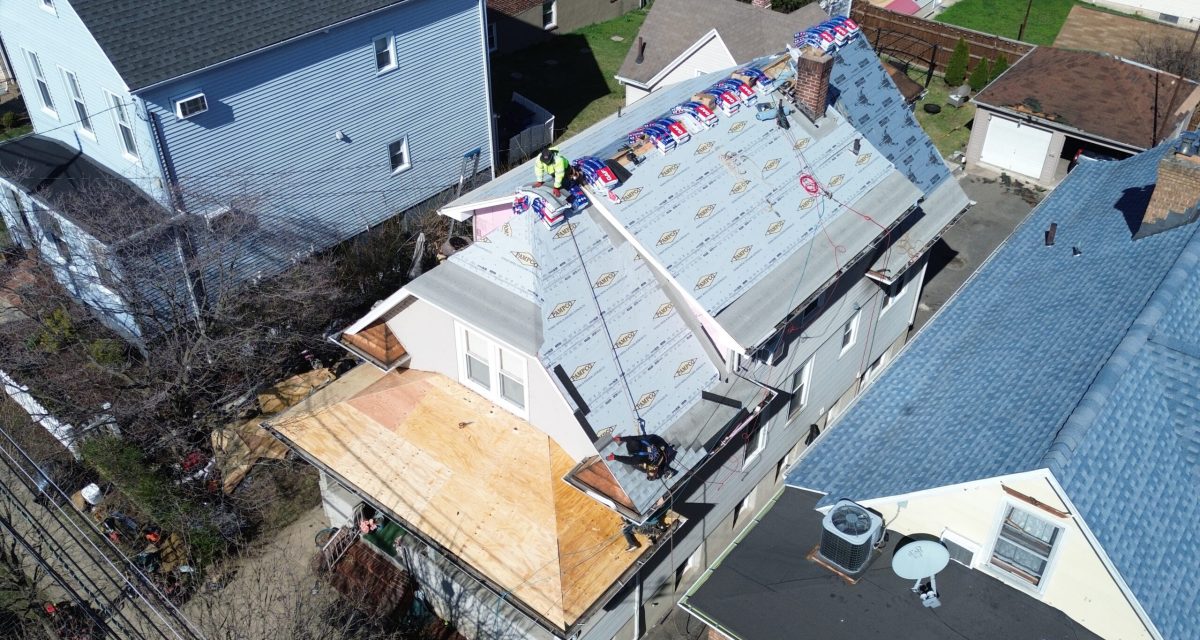
What the Project Photo Shows
The aerial photo shows roof decking replacement and re-roofing underway on a New Jersey home. Several details stand out:
- New plywood sheathing. The light-colored panels on the lower roof are fresh decking, installed before any roofing goes on.
- Synthetic underlayment. The gray-blue layer across the main slopes is a water-resistant barrier that protects the deck until the shingles are installed.
- Staged shingle bundles. Bundles are placed along the ridge so the crew can work down the slope efficiently.
- Fall protection. Roofers are working with harnesses and ropes, which is standard practice on steep or multi-level roofs. For safety rules, see OSHA’s fall protection guidance.
- The chimney. The masonry and flashing at the chimney are a key detail, because the deck around penetrations is where rot often starts.
Seeing a roof at this stage is a reminder that the work that protects your home happens before the shingles go on.
Roof Decking Replacement Cost Factors
Prices vary, so be wary of any single number quoted without an inspection. The main factors are:
- Amount of damage. A few sheets cost far less than a full-roof deck.
- Material. Plywood and OSB prices fluctuate, and thicker panels cost more.
- Roof size and pitch. Steep or multi-level roofs take more time and safety equipment.
- Access. Dormers, porches, and tight lots slow material handling.
- Combined work. Doing roof decking replacement at the same time as a full roof replacement is typically more efficient than doing it separately.
- Underlying causes. Leak, flashing, or ventilation repairs add to the scope.
Ask for a written estimate that explains how extra decking will be priced per sheet, so there are no surprises mid-job. All State Roofing & Chimney offers free in-house estimates.
When to Schedule Roof Decking Replacement
The best time for roof decking replacement is during a full roof replacement, when the shingles are already off and every panel can be inspected. Spring and fall offer mild temperatures and drier days, but a good crew can work year-round by planning around the forecast. If you have an active leak, do not wait for the perfect season. Emergency tarping can protect the home until the deck is repaired.
Ventilation and Moisture Control
Decking rots when it stays wet. Poor ventilation lets warm, humid indoor air condense on the underside of the deck in winter, and it bakes the wood in summer. A balanced system, with intake vents at the eaves and exhaust vents near the ridge, keeps the deck dry. Bathroom and kitchen fans should vent outdoors, not into the attic.
A roof decking replacement is the best time to correct vents, so the new wood is not exposed to the same moisture. Gutters matter too. Clogged gutters push water back onto the roof edge, where the deck is most exposed. Our gutter services help keep water moving away from the house.
Why Roof Decking Replacement Is Not a DIY Job
- Safety. Rotted decking can fail underfoot. Trained crews know where to step and how to anchor.
- Structure. Cutting and replacing panels requires support on rafters and correct fastening patterns.
- Code and warranty. Poor deck work can void shingle warranties and fail inspections.
- Speed. A crew can open, repair, and dry in a roof quickly, which protects the house from weather.
- Weather risk. An open roof is a leak waiting to happen. Professionals plan the work so the roof is covered before rain.
How to Choose a Roofing Contractor
Roofing is a major investment. Use this checklist:
- Verify registration. New Jersey home improvement contractors must be registered. You can check through the NJ Division of Consumer Affairs.
- Ask for proof of insurance, including liability and workers’ compensation.
- Get everything in writing, including scope, materials, the per-sheet price for extra decking, and the warranty.
- Compare estimates, but do not choose on price alone.
- Read recent reviews and look for patterns about honesty and cleanup.
- Look for professional standards. The National Roofing Contractors Association is a good source of industry guidance.
Why Homeowners Call All State Roofing & Chimney
All State Roofing & Chimney is a locally owned, licensed, and insured contractor serving Bergen, Passaic, Hudson, Essex, Morris, Hunterdon, Somerset, Sussex, Union, and Warren Counties. The crew handles the whole roof system, so your deck, underlayment, shingles, flashing, and chimney are all looked after by one team.
What homeowners can expect:
- Free inspections and free in-house estimates.
- Same-day service where possible, and emergency roofing when a storm hits.
- Complete solutions, from roof leak repair to full roof replacement and new roof installation.
- Chimney expertise, including chimney repair and flashing, where deck damage often starts.
- Clear communication about what is damaged and why.
You can see the towns we cover on our locations page.
Frequently Asked Questions
How do I know if I need roof decking replacement?
Sagging areas, soft spots, ceiling stains, daylight in the attic, and moldy wood are the main signs. A professional inspection confirms it.
Can decking be repaired instead of replaced?
Small cracks in sound wood may be acceptable, but rotted, delaminated, or soft panels must be replaced. Patching damaged wood only hides the problem.
Is plywood or OSB better for roof decking?
Both work when installed correctly. Plywood tends to handle moisture better and dries faster, while OSB is often more economical. Your contractor can recommend one based on your roof.
How long does roof decking replacement take?
A few sheets can be replaced in hours during a re-roof. Larger areas take longer, depending on roof size, weather, and access.
Will new decking add to my roof replacement cost?
Sometimes. Because damage is often only visible after tear-off, ask how extra sheets are priced before work begins.
Can new shingles go over old, damaged decking?
No. Shingles need a solid, dry deck. Installing over damaged wood leads to leaks, loose shingles, and voided warranties.
Does insurance cover roof decking replacement?
It depends on the cause of the damage and your policy. Storm damage may be covered, while long-term rot usually is not. Check with your insurance provider.
Conclusion
Roof decking replacement may be invisible when the job is done, but it is the foundation of a roof that lasts. Catching soft, stained, or rotted decking early protects your shingles, your attic, and the rooms below. A thorough inspection, honest pricing, and careful installation make all the difference.